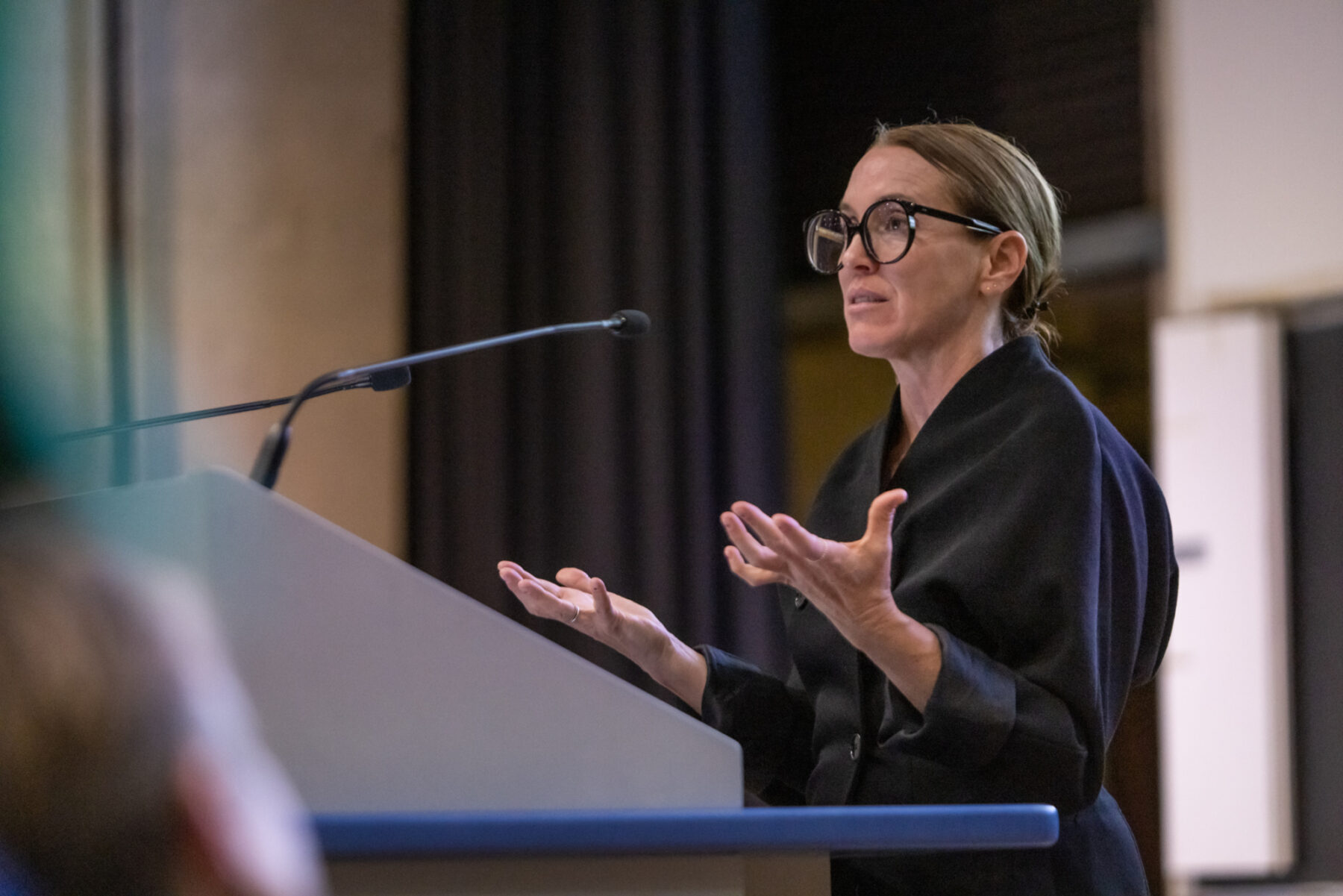
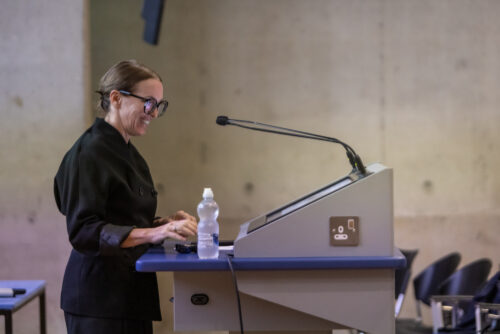
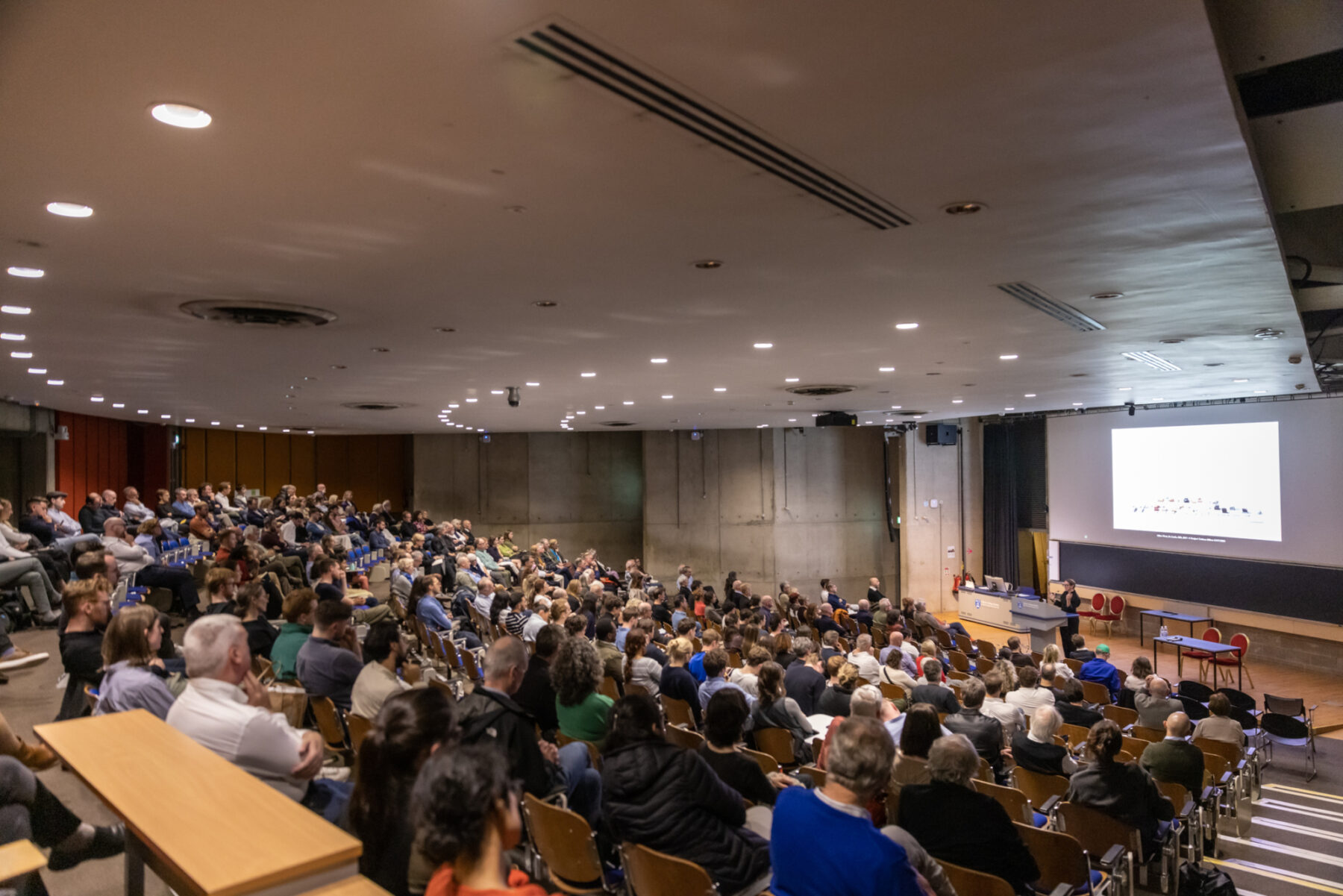
Tatiana Bilbao - Architecture as a Collective Art The second lecture in the Niall McCullough Lecture Series was given by Tatiana Bilbao on Thursday 18th September 2025 in the Edmund Burke Theatre, Trinity College Dublin.


Introduction by Valerie Mulvin
Thanks to you all for joining us this evening – this is the second Niall McCullough lecture in a series which will run annually for five years. Niall died in August 2021 and I lost my life’s companion and partner in architecture, and Dublin and Ireland lost a great architect, writer and thinker. To celebrate and remember Niall, and to keep his inspiration, and clarity alive, the idea for these lectures was born in conversations with close friends - to focus on what fascinated Niall – architecture modern and ancient, the city, books, film, archaeology, history, music, photography, and so on, as departure points for new discussions and bright collaboration.
The lecture series is presented by myself; and by our office, McCullough Mulvin Architects with particular help from Ruth O'Herlihy, Corán O'Connor and Caoimhe Mac Andrew; and a group of close Friends – Denis Byrne, Maggie Moran, Sandra OConnell, and in particular, Ray Ryan, who used his legendary powers of persuasion to tempt Tatiana to visit Dublin. I sincerely thank all of you for your spark, energy and insight in making this series a real possibility. I’m also very grateful to the Department of Foreign Affairs, the RIAI and Trinity College who have generously supported this event.

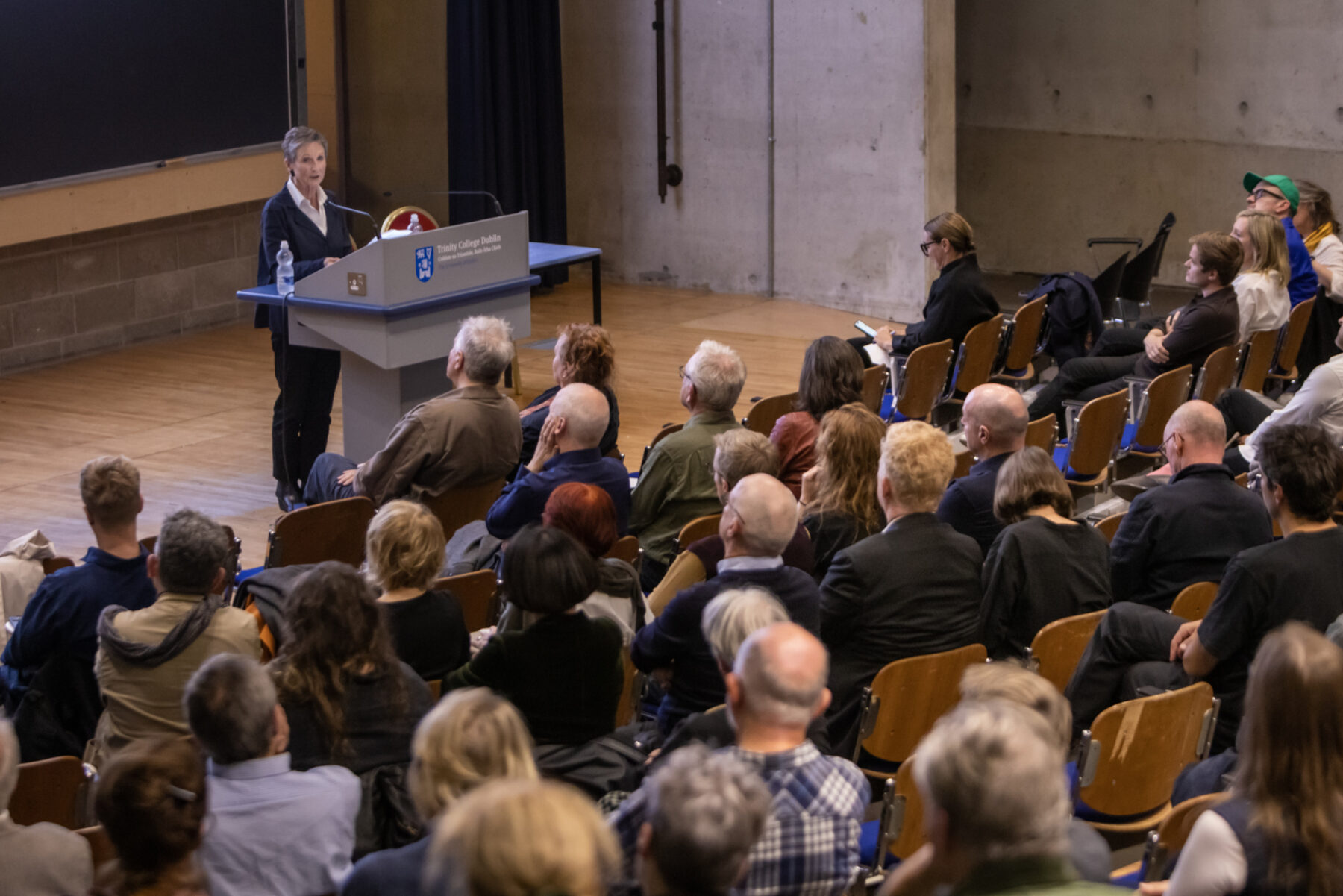
Tonight we are hugely honoured to have with us Tatiana Bilbao, who has travelled from Mexico City to be with us tonight. Niall and I never did get to Mexico, although we planned it for years and never seemed to have enough time, then found we had no time at all. We were fascinated by the sheer inventiveness of a place where every incursion from somewhere else seemed to translate into a new and invigorating architectural expression. It seemed a palimpsest of extraordinary richness in the 15th and 16th century created by strongly rooted indigenous culture and traditions of craft and making, overlaid by imported Renaissance principles of architecture, and then in the 20th century, the freewheeling modernism which exploded into a fresh and innovative architectural culture.
And I think we would have felt very much at home wandering the landscape, observing ordinary buildings as we did to make A Lost Tradition a long time ago – resonances are strong and beautiful between the two places and worth stating – both stretch things very thinly - nothing is wasted, they are there to serve a purpose, not just functional but also as portals another world; simple materiality reduces decoration to almost nothing; there’s a requirement for economy; roofless boxes which once sheltered vivid lives are loosely arranged, held together with a spiritual gravity, their architecture speaking directly to people for whom symbols are signifiers of real import; and those symbols can also be the familiar, typological elements of an architecture which knows how to speak clearly. So we were hugely interested in this unique PLACE, and the variety of its landscapes and buildings.
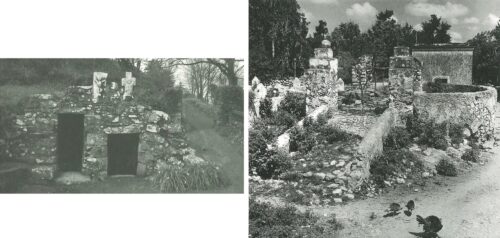 Holy Well at Ardmore in Co. Waterford and Village Well in Yucatan
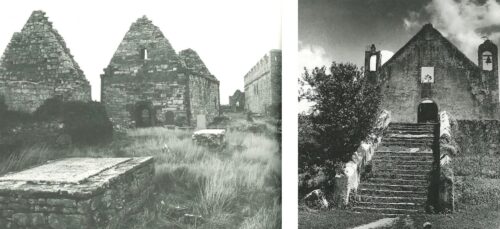 Ardfert Catherdral, Co. Kerry and Parish Church, Quintana Roo
And Tatiana’s work in Mexico is of course set against what we regard here as an exotic landscape. Along with most of the people in this room, we were keen to see the 20th century drama of colour and form that we knew through publications – the work of Luis Barragán with its lyric enclosures, animals and chutes of water, his own descriptions of growing up in a town where water was brought through the town elevated on wooden pipes, dripping and moss covered. And this, almost magic-realism world, exists in parallel with modernist architecture, like Juan O'Gorman making studios for Frida Kahlo and Diego Rivera, or where art and architecture are integrated into murals on the Library of the University of Mexico - these conjunctions are fantastic and make an inspirational context for the range of work Tatiana has been involved in.
 Kilfenora Cathedral, Co. Clare and Augustinian Chapel, Hidalgo
 Timoleague Friary, Co. Cork and Dominican Monastery, Oaxaca

Our own fervent interest in geometry made it certain we would be interested in Tatiana’s work, which we first saw on her very brief visit to Dublin - in perhaps 2015? – I seem to remember she described her collaboration with artist Gabriel Orozco on his beach house, where geometry and nature were linked in a beautifully judged arrangement of geometric pools and living spaces on the edge of the Pacific.
 Glendalough, Co. Wicklow
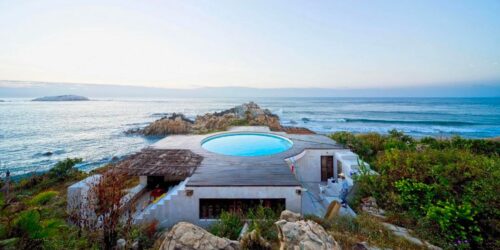 Observatory House for Gabriel Orozco


There are resonances in Ireland with the infrastructure Tatiana created along a 100km long pilgrimage route to a remote part of Mexico where the Virgin Mary is said to have appeared. Working with a number of other architects and artists, she made what been called in one publication, a Landscape of Faith: which focuses on a series of very abstract stations - at once poetic and deeply pragmatic places to rest, sleep, wash and eat. And we are no strangers to the mythic qualities of – pilgrimage routes, patterns, ritual sequences, including this one at St. Patrick’s Purgatory in Lough Derg, Co. Donegal, Seamus Heaney’s Station Island - where pilgrims from all over medieval Europe used to come to visit the cave here, the conjunction of upper world and underworld, a place of horror and dreams and a place to examine your life. And linking these differing briefs, her projects have a significant thread about working with place and landscape, taking nature as inspiration and starting point.
 St. Patrick's Purgatory, Lough Derg, Co. Donegal - perpetual fragments
So when our group of Friends discussed who we would like to speak with us this year, Tatiana Bilbao seemed like a natural fit with Niall’s interest in architecture and landscape, in how things develop slowly over time and through space, you amend as you go because you see opportunities as things evolve.
Her projects are diverse – she is equally at home designing a research aquarium for marine and terrestrial ecosystems - which she considers like a ruin in the landscape, invaded by plants - as she is building flexible, useful and incredibly economic housing projects for the most disadvantaged in her country. That’s another interesting point of intersection – a natural sympathy with the idea of ruin – from our time spent in Rome after we graduated, ruin was a daily discovery, involving hubris, awe, poetry, loss, and so on, as we sat on one set of monuments drawing another… but there are modern equivalents, which I’m sure Tatiana would appreciate. - When our Morgue building, a Medico Legal Centre for Dublin – stopped halfway through when a builder went under in the crash, the structure stood as a ruin, with rain falling and light coming through cracks for a very long time, together with samples of roach bed portland stone, the fossils in which seemed like the perfect material for a building about death. Niall photographed it through the stages of its decay and destruction until the client finally demolished it completely, giving us a humbling sense of frailty as architects – we pile up stones against an uncertain future like the angel of history.
 Medico Legal Centre, Dublin
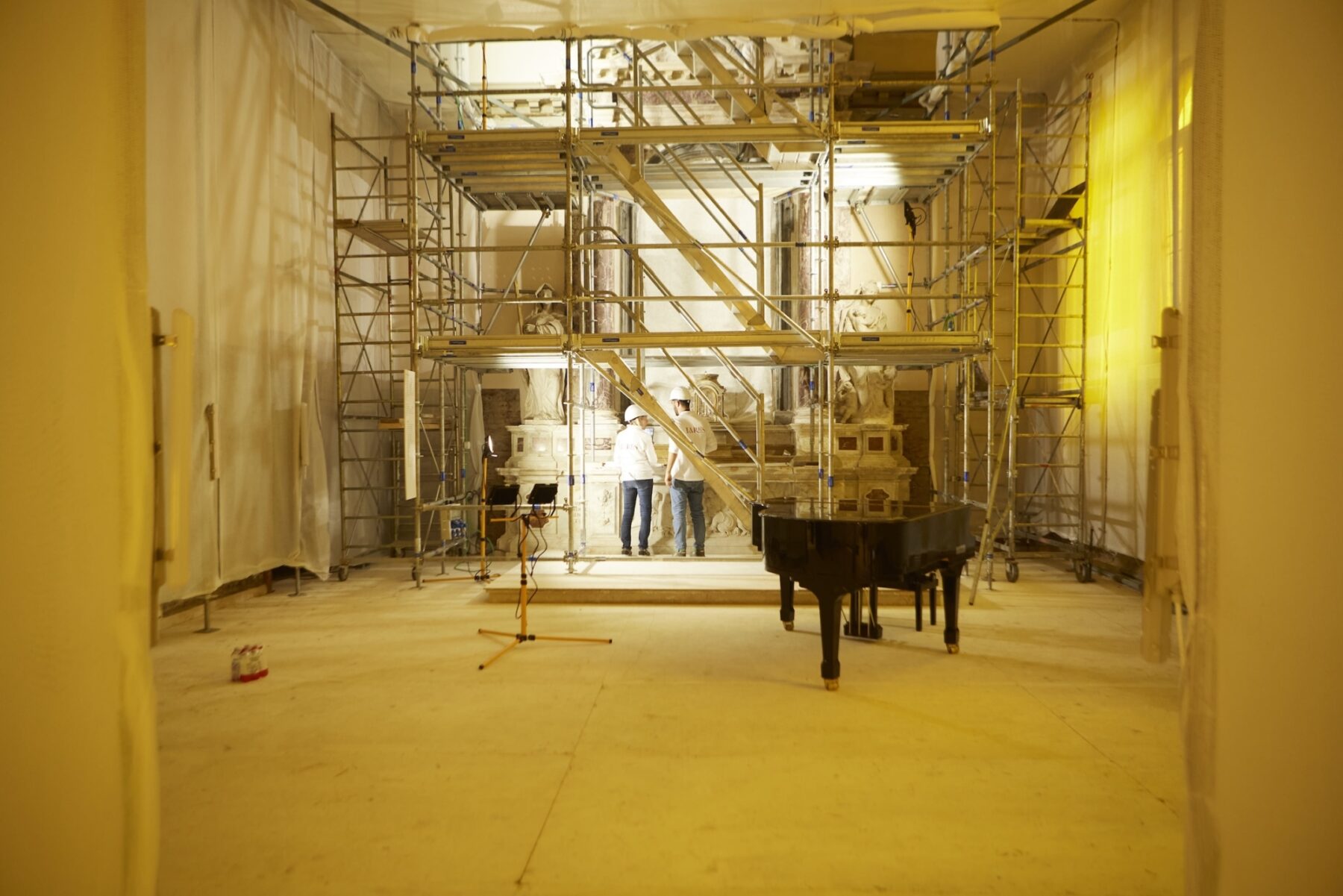
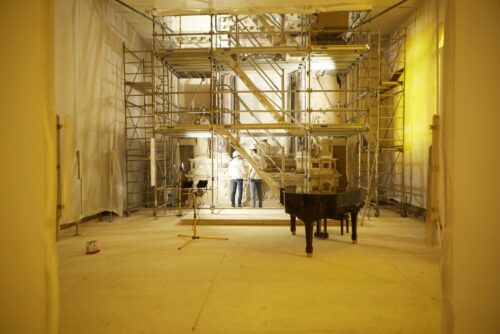 Holy See Pavilion, Venice
Tatiana communicates in a highly individual way, speaking directly to people in hand drawn collages rather than computer generated images, assembling meaning through the iteration of lines. Known for her collaborations with other architects, she begins conversations across territory rather than projects about statement. In an interview with Jacques Herzog, she talks about these informal networks of collaboration and their importance for her – "It’s all about the architecture we can do, not about us being the architects…the importance of the space, not of the person behind it…" she says. And having spent only the shortest of time with Tatiana since she arrived, I can say that these self effacing qualities, which I like so much, are truly written right through her – she is generous, open and kind.
And most significantly, Tatiana’s collaborative spirit also suggests the generosity that is slipping away from us as a society in an era of self interest, her creative and intellectual resources have been directed towards projects of social responsibility, of close attention to the issue, to the idea of care. She is interested in giving control back to people, in empowering women to improve their communities themselves, in making social housing out of incredibly scare resources, giving people beauty, not just a box. As Tatiana says, we all need beauty to evolve. That’s a very simple concept but incredibly important to us too. Her housing brings beauty to people who have very little, houses of dignity which are grouped together to share a communality of values. She does social housing better by thinking about it. And the numbers are illuminating: Mexico, with a population of 120 million people, is trying to build one million houses a year. Our problems seem like child’s play.
And finally, her work at the pavilion of the Holy See in the Venice Biennale this year – again collaborative and open ended. I loved reading her inspiration in Umberto Eco’s 1962 thesis – called Opera Aperta, or Open Work - and how Tatiana’s work is a continuity of that generosity and openness, where a project is completed by the people it is made for – here a conservation project recovers the memory of a forgotten church yet sets it within a community of care.
But lets listen to Tatiana Bilbao herself, a great and generous architect of our time, to speak on Architecture as a Collective Art
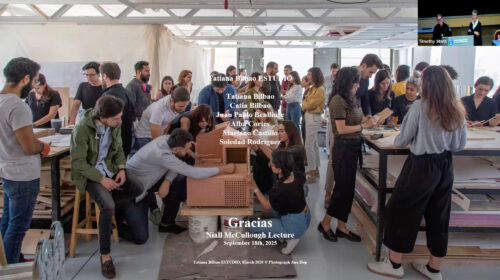
Very regrettably, a technical glitch in the recording resulted in corruption of the audio file. The visual recording is presented here so that the drawings and images of Tatiana’s presentation can be viewed.
—Niall McCullough Lecture, 18th September 2025